Facing a situation which is far as I know is quite dire regarding learning trade skills in the UK, I've had to adapt to make first steps which have got me going on the road to learning about things I want to know about! I've worked in "Technical Colleges" in the UK. One of the signs of the problem is that they have been renamed "Further Education Colleges" and are trying to take post-secondary-school purely classroom feeds while trying to extinguish courses like Welding and Civil Engineering (well, they are "legacies lingering in 'Post Industrial Britain'" (sic.) and they cost more money to run that just lines of tables in classrooms with one teacher on short-term contract purveying the light-as-a-marshmallow **** these courses are).
So - there's been my ropes and knots work. And in Spring 2008 I've returned to welding school, aiming to make my skills rise to some realistic level of capability. Initially this was totally absorbing my attention. However, while going to welding school remains hard work, it has taken on its own momentum and is mainly looking after itself now. Which left me free to turn my attention to my next "supporting skill" associated with my welding / fabricating and steel erecting work...
When you can do ropes, knots and splices to some level of skill, attention at some time is going to alight on the fact that there there are block-and-tackle sets, where a system of pulleys ("sheaves" in this terminology) in a "shackle block" (fixed) and a "hook block" (moving with the load) joined by runs of rope or cable can give mechanical advantage. That enables you to hoist a heavier load than you could otherwise do unaided.
I'd been influenced in my line of thoughts by "Discovery Channel" programs like the one about building the new Hoover Dam Bypass Bridge in Arizona / Nevada. Because of the huge span across the Black Canyon in which the Dam is built, they had to use a lifting method know as a "highline". Simplified: you have to wind things into place along steel cables spanning across the canyon. So this is pretty inspiring stuff. Web-surfing soon got me more detail on this project then cascaded into others needing significant lifting capability.
However, as a start, no-one has a block-and-tackle set I can borrow, as far a I have yet found. And the skill isn't widely taught either. Armed with a Canadian book of "Boilermaking" skills for apprentices to learn (corrupted by its influence?) I thought "where to next?".
Facing such a dire situation, one way of getting started occurred to me - get a "Meccano" set for making mechanical models. Light comes on in mind - that is what they are for. So ordered one mail order...
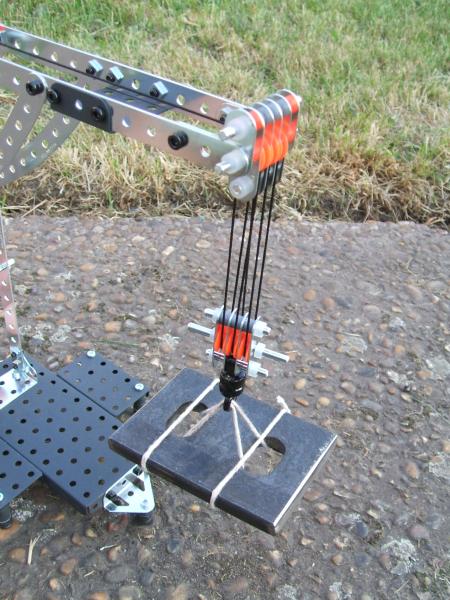
Here is the first fruit of the effort. I've managed to correctly reeve this model block-and-tackle. The "cables" run freely, not crossing and scrubbing together, and the hook-block takes the load in a balanced way, staying level and not tipping with applied load.

One of the things you can see is that the hook-block is at right-angles to the fixed/shackle-block. Which matches the real use of multi-sheave block-and-tackles.
"Reeving" a block-and-tackle is how you run the rope or cable over the sheaves. When you have more than two sheaves on either block, the way you have to reeve becomes difficult to superficially visualise. Reeving a 3-by-3 block combination (3 sheaves on the shackle-block and 3 sheaves on the hook-block) is a classic case. 3-sheave blocks seem commonly met.
I followed the diagrams in the "boilermaking" apprentice manual. Having done it a couple of times, the logic became clear and I can reeve these model blocks now without having to follow a manual step-by-step.
Why 3-by-3? Well, the set-up should give you a 6-to-1 Mechanical Advantage (M.A.). That is, so you have to haul in six times as much length of rope as you lift the load, but on the other hand you can manage a load six times heavier than unaided. However, each sheave has its own friction and I am told that if the number of sheaves becomes many, the friction can so sap your apparent M.A. that you are no better off, pulling in more rope but not lifting more load. So it is a guess which I will see stands the test of time that if you want to manually lift a very heavy load (you are going to be able to lift it though it is going to be slow) you use a chain-block with a huge mechanical advantage and a finite total friction loss which is reasonably controlled.
There is a diagram of a stiffleg derrick in the "Boilermaking" manual I mentioned. And they are mentioned in this article (external link) on the Hoover Dam Bypass Bridge and Web-surfing on contractors mentioned found comment that "Stiffleg Derricks would be familiar to the Egyptians building the Pyramids" but that "they are all triangles" and handle loads very efficiently - such that where they can be used in a fixed location, they are formidable machines.
Plus I found that making useful smallish examples of stiffleg derricks is achievable. A wooden stiffleg derrick about shoulder-height to a person is described in detail which will easily lift 400kg stones for building projects. So this seemed the way to go.
And here is the outcome:

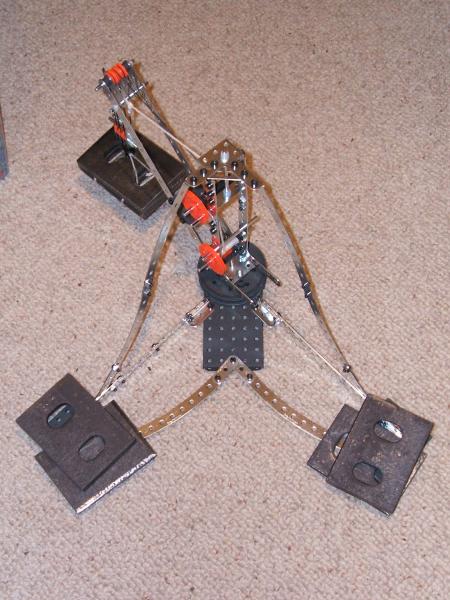
By the way - the curved plates in the "stiffleg" back of the derrick - they should be straight! It's just that they were the only plates I'd got left in the Meccano set!
The model easily lifts weights at least twice its own weight - not a bad ratio! It needs ballast on the end of each leg, each one ballast weight being the weight being lifted. Guess that if the ballast swung opposite the load you might only need one ballast matching the weight of the load - but then there would be a lot of prices to pay, in the sophistication of the mechanism - and the operating reality that you would have the counterbalance swinging around denying access area to the crew operating at the site. By the way - a major use of stiffleg derricks seems to be on high-rise buildings and on bridges, where the ends of the stifflegs can be bolted to the structure so far erected. This avoids any need for ballast / counterbalance weight. So instead of burdening the in-construction structure with further "dead loads", the structure is efficiently transmitting the lifting forces passed on by the light-in-itself derrick, giving the "formidable" hoisting characteristics of derricks.
So where does all this lead? Well - that is where I am hopeful. There is nothing like actually trying the fundamental methods at the root of each skill to build a wider appreciation of the area, and start on a path of wider understanding. I am hoping to make a wooden-framed stiffleg derrick - which might be useful for gardening and small mechanical projects - but mainly to experience handling something a step up in size with real lifting capability.
So let's see...
R Smith, 26 May 2008